
Landscape Design Intelligence is the method behind every Fluid Form Studio project. It treats a site as a system that can be read, modelled and tested, not just drawn. The easiest way to explain it is through four layers.
Environment
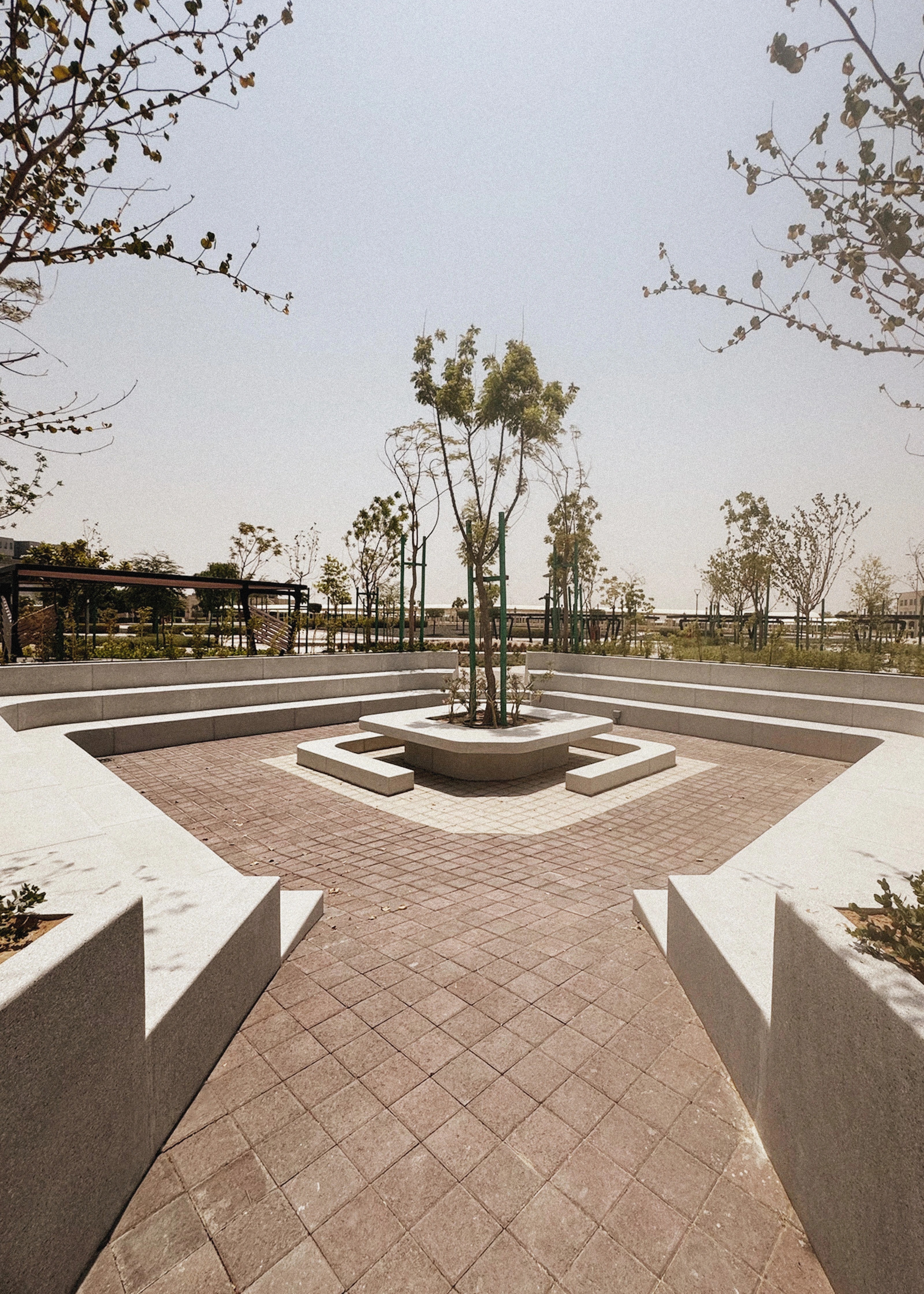
Climate, shade and comfort, read from open data and modelled to the site. On a campus landscape of around 20,000 square metres in Abu Dhabi, the environment layer told us the planting had to hold the site through the dry seasons on minimal irrigation.
That is why part of the planting uses Arabian natives: gravel beds with arid tolerant ghaf, acacia and frankincense.
Behaviour
How people really use a space: dwell, activity and return visits. A campus is a place of crossings and gatherings. A sequence of courtyards radiates from one central crossing, each planted with a blend of ornamental and native species chosen to read as common ground.
Economics
What the landscape costs to build and what it earns back. We price the design per square foot from live nursery and supplier pricing plus labour, and set it against a value model. Planting chosen for the climate costs less to keep alive, which shows up year after year.
Time
How the planting grows, blooms and ages, month by month, matched to local nursery stock. On the campus, Indian natives such as tamarind, neem, moringa and palm are planted as a living trail along the central approach, exotic species chosen as much for memory as for shade. A design that ignores time looks best on the day it is handed over and worse every year after.
From input to outcome
A designer controls shade, seating, planting and water on day one. Those inputs change behaviour, meaning dwell time, activity and return visits. Behaviour produces the outcome the developer and operator are paid for: spend, premium and retention. Design intelligence links all three, and the four layers make the link explicit.
Why it matters
Interiors get the budget and outdoors get leftovers. When the outdoor space is shown to perform, that changes. Every move is commercially defensible, because every move has a reason behind it.
Share on LinkedIn